Finance
Financial Architecture and Value Creation
Pedro I. Bustillo Richter — Interim CFO
What is Financial Architecture?
During my career as CFO, FP&A leader, and advisor, I have worked with companies in very different situations: high-growth businesses, private equity-owned platforms, subscription models, consumer products, manufacturing operations, and businesses facing liquidity pressure.
Regardless of the industry or business model, management teams, investors, and lenders ultimately ask the same question: how much value can this business create?
In my experience, no single metric answers that question. I have seen companies report strong revenue growth while destroying shareholder value. I have seen businesses improve EBITDA while struggling to generate cash. And I have seen companies with modest growth command premium valuations because their economics, execution, and capital discipline were fundamentally stronger.
Over time, those experiences shaped the way I evaluate businesses. I refer to this framework as Financial Architecture: the combination of governance credibility, business fundamentals, and capital efficiency that supports sustainable value creation.
The concept is grounded in a simple observation: financial results are the consequence of multiple business decisions interacting with one another. For that reason, when assessing a business, I focus first on the architecture supporting the financial statements — not the statements themselves.
The three pillars are closely connected. Weakness in one area eventually affects the others. Only after understanding all three can we assess whether a company’s current performance is sustainable — and whether its valuation is justified.
Governance Credibility
Before discussing growth, margins, or valuation, I need confidence that the financial statements reflect the economic reality of the business. This sounds like a basic requirement. It is surprisingly often not the case.
Every business decision ultimately relies on financial information. If that information is incomplete, inconsistent, or inaccurate, management risks making the wrong decisions regardless of how well-designed its strategy may be.
My analysis always starts here. Governance credibility reflects the level of confidence that management, lenders, investors, and other stakeholders can reasonably place in the reported numbers.
In practice, I focus on the areas where management judgement has the greatest influence on reported results: revenue recognition, the valuation of significant assets and liabilities, and the adequacy of reserves and provisions. The objective is to ensure that accounting policies are consistently applied and that the statements appropriately reflect the underlying economics — not a version of them optimized for optics.
For private companies — particularly those approaching a capital raise or a transaction — I recommend implementing financial controls that can scale with the business well before any investor is in the room. The discipline this installs is worth it. Deterioration in business quality almost always appears in receivables, inventory, or deferred revenue long before it shows up in reported earnings.
Compliance with accounting standards is a
minimum requirement. Governance credibility goes further: its purpose is to
give management reliable information to allocate resources, evaluate
performance, identify risks, and make better decisions.
Business Fundamentals
Once confidence in the numbers has been established, the analysis moves to the business itself. Financial statements tell us what happened. Business fundamentals help explain why — and whether it is likely to continue.
Revenue Quality and Competitive Position
Not all revenue is equally valuable. To assess the quality and sustainability of top-line growth, I look at the competitive environment in which the business operates and monitor indicators such as pricing power, market share trends, customer retention, acquisition economics, and product mix.
Competitive dynamics have a direct impact on both growth and profitability. Low-price competitors may force premium brands to reduce prices or invest more heavily in brand building and innovation. Markets with low switching costs tend to experience higher churn and rising customer acquisition costs. Increasing customer expectations around service and delivery can improve satisfaction while simultaneously increasing the cost to serve.
The right question is not just whether revenue is growing. It is whether the business can defend that growth — and at what cost.
Structural Profitability
These competitive dynamics ultimately show up in margins. Profitability is shaped by pricing, product mix, customer mix, sourcing, logistics, operating leverage, and competitive intensity. When margins change, management needs to understand which factors are responsible and how they relate to the broader competitive position of the business.
High margins in a commoditizing market are temporary. Sustainable profitability comes from competitive positioning — from a business that can command loyalty, defend pricing, and resist new entrants. The analysis has to distinguish between the two.
The objective is not simply to explain
historical profitability. It is to assess whether the current profit structure
is sustainable and whether future growth is likely to strengthen or erode the
economics of the business.
Capital Efficiency
The third pillar is where strategy meets financial reality. Every business initiative requires capital — working capital to support growth, manufacturing capacity, technology, acquisitions, or geographic expansion. Understanding how that capital is allocated and what returns it generates is central to value creation.
Capital Allocation
Capital allocation starts with a business requirement or growth opportunity. The discipline I apply is straightforward: what cash flows is this investment expected to generate, how much capital does it require, and do the expected returns justify the commitment?
The measures I rely on here are Free Cash Flow to the Firm (FCFF) and Return on Invested Capital (ROIC):
FCFF = NOPAT + D&A + other non-cash items −
normalized working capital investment − capex
ROIC = NOPAT ÷ Invested Capital
Value is created when ROIC consistently exceeds
WACC. When it does not, growth is destroying value regardless of what the
revenue line shows.
Once an investment has been approved, management determines the appropriate financing — internally generated cash, debt, equity, or a combination. Financing affects liquidity, leverage, and risk. It does not change the underlying economics of the investment itself.
Capital Productivity
Capital allocation decisions do not occur in isolation. They are influenced by how efficiently existing capital is already being used. Similar levels of revenue growth and profitability can require very different amounts of capital depending on the business model.
Measures such as asset turnover, receivable collection periods, inventory turnover, working capital intensity, and capex requirements help explain how efficiently the business converts invested capital into revenue, profit, and cash. The objective is not to optimize any individual metric — it is to understand whether capital requirements are improving, deteriorating, or holding steady as the business scales.
Actual performance should then be compared against original assumptions. This creates a continuous feedback loop linking business strategy, capital allocation, financial performance, and value creation.
Value Creation and Valuation
The purpose of this framework is not to calculate a valuation multiple. It is to understand the factors that determine a company’s ability to create value over time.
Strong business fundamentals support profitability and cash generation. Capital efficiency determines whether those profits translate into attractive returns. Governance credibility provides confidence that the reported results accurately reflect the underlying economics. Together, they give a more complete picture of the company’s ability to create value — and a more honest basis for any valuation discussion.
Companies with durable business
fundamentals, disciplined capital allocation, and credible financial reporting
tend to generate more sustainable cash flows. Valuation is the consequence of
those characteristics, not the starting point of the analysis.
Microsoft: A Practical Illustration
Microsoft illustrates how these three pillars work together over a sustained period.
The company expanded across enterprise software, cloud infrastructure, cybersecurity, developer tools, and AI-enabled services — while simultaneously maintaining governance discipline, defending pricing power, and generating returns well above its cost of capital. Its valuation re-rating was not driven by revenue growth alone. It happened because investors became confident that Microsoft could continue creating economic value while reinvesting at scale.
The chart below makes the distinction visible:
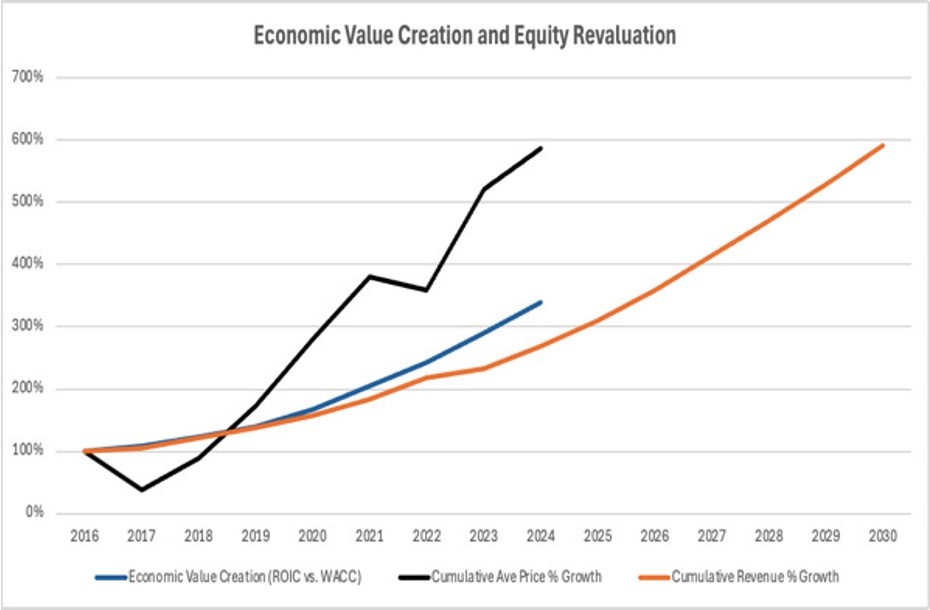
Economic Value Creation (ROIC vs. WACC),
Cumulative Share Price Growth, and Cumulative Revenue Growth — Microsoft
2016–2030E.
Revenue growth and share price tracked closely for years. The re-rating accelerated when ROIC pulled decisively ahead of WACC — when the market became convinced that every incremental dollar Microsoft reinvested was generating returns above its cost of capital. That is what premium Financial Architecture looks like.
Final Thoughts
In my experience, understanding a business requires more than reviewing revenue growth, margins, or valuation multiples. The more important questions are: Can the financial statements be trusted? What business drivers explain the current performance? How sustainable are those drivers? How much capital is required to support them? Are the returns generated sufficient to create value?
Financial Architecture is the framework I use to answer those questions — across growth businesses, distressed situations, pre-transaction environments, and everything in between.
Valuation is not a starting point. It is
the consequence of the decisions management makes regarding governance,
business strategy, and capital allocation.