AI & Finance
AI AND OPERATIONAL IMPROVEMENT
Purpose and Central Argument
This article examines AI and operational efficiency from a business perspective, focusing not on AI’s technical characteristics but on its role as an enabler of productivity improvement.
The central argument is that AI changes the economics of operations when better prediction reduces uncertainty at a critical point in the operating system, and when the organization can redesign decisions, actions, workflows, and feedback around that improvement.
Two concepts follow from this: AI as a prediction tool, and the operating process as a set of tasks directed toward a business outcome. As this article will explain, a technology implementation creates value only when its cost is lower than the net productivity benefit it produces. Many companies incur significant AI-related costs, including tokenization costs, without clearly defining the business objective or assessing whether the return on investment is positive. Automating one task within a broader process can also create new inefficiencies, reducing overall returns below expectations.
Working thesis: Better prediction creates value only when it changes a decision, improves workflow, and produces a stronger economic outcome.
The Two Conceptual Foundations
AI as productivity multiplier
Automating a task means designing a system that can anticipate the
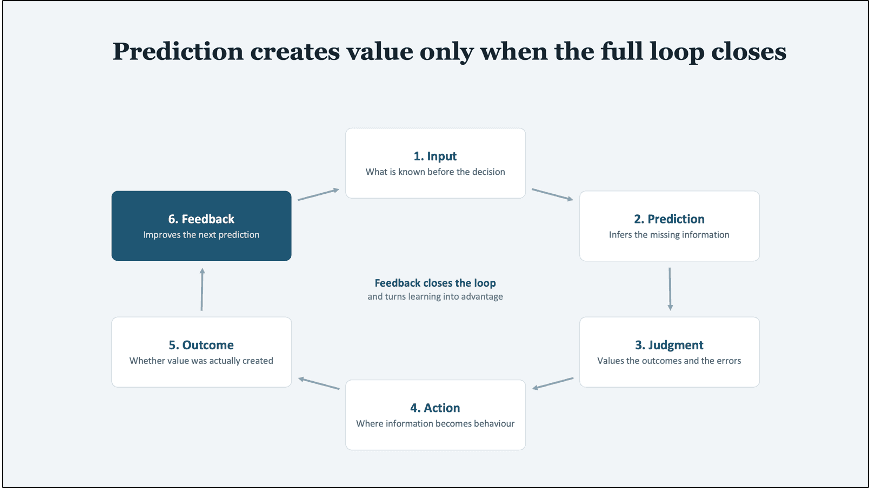
next step in a sequence and execute the task from beginning to end. In this sense, AI can be understood as a technology that makes prediction cheaper, faster, or more accurate. Prediction is the use of available information to infer information that is missing. Most of the time “prediction” is associated with the “future”, but in a broader business sense it can also involve classification, recognition, recommendation, intent, risk, or the likely response of a person. Operationally, prediction is part of a continuous loop: inputs generate predictions, predictions inform judgment, judgment leads to action, actions produce outcomes, and outcomes create feedback that improves future predictions.
AI becomes a productivity multiplier when it speeds up decisions and actions across an entire task, not just a single event. By applying prediction to operational data, it can recommend what should happen next, trigger action, and help the system learn from results. What is new is the scale and speed at which this cycle can now run, enabled by technologies such as machine learning, deep learning, neural networks, and large language models. Although these technologies are not the focus of this article, tools such as ChatGPT and Claude illustrate how these large-scale prediction capabilities depend on a vast deployment of IT assets such as data centers and processing power.
This raises an apparent contradiction. If AI makes prediction cheaper, why are many companies finding that AI operating costs, including tokenization and inference costs, are higher than expected?
The distinction is between the cost of an individual prediction and the total cost of prediction consumed by the business. As prediction becomes cheaper and easier to deploy, organizations can use vastly more of it. Generative AI applications may involve millions of interactions, repeated model calls, increasingly large amounts of data and tokens, and the infrastructure required to process them. The unit cost of prediction can therefore fall while total AI expenditure increases substantially.
This distinction is critical when evaluating AI as a productivity investment. Cheaper prediction does not automatically mean cheaper operations. The economic benefit created by better or faster prediction must ultimately exceed the additional AI costs, together with the human and operational resources that remain necessary to execute the process.
AI creates economic value when the improvement in the business outcome exceeds the incremental AI, human, and operating costs required to achieve it.
A business process
A business process can be defined as a sequence of
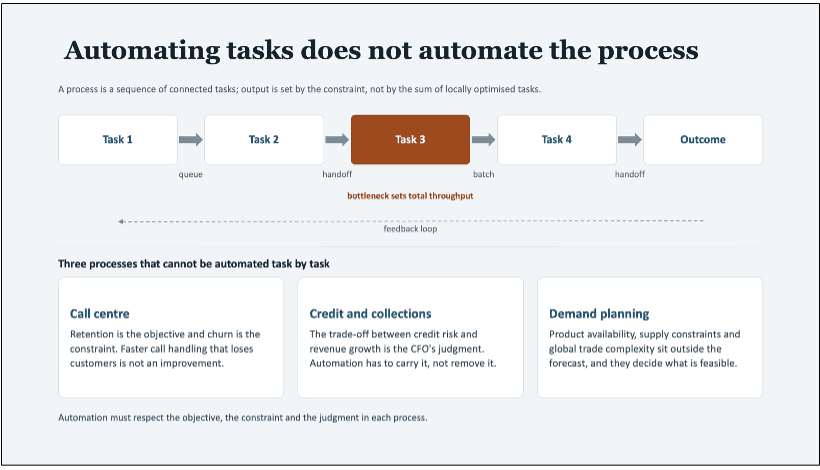
connected tasks that together produce a final outcome. If we take the logic of a manufacturing process and apply it to business operations more broadly, it becomes clear that system performance is not simply the sum of locally optimized tasks. Output is constrained by bottlenecks and by the way work moves through queues, handoffs, batches, and feedback loops. Consider common business processes such as a call center, credit and collections, or demand planning. Can a call center be fully automated without understanding the critical objective of customer retention and the constraint of churn? Can credit and collections be automated without preserving the CFO’s judgment around the trade-off between credit risk and revenue growth? Can demand planning be automated without accounting for product availability, supply constraints, and global trade complexity?
These are examples of critical tasks within end-to-end business processes and objectives, including customer retention, cash flow management, product availability, and working capital optimization.
Identify end-to-end business process tasks and constraints
A common approach begins with the technology: Where can we use AI? The combined framework suggests beginning with the operating system instead. First identify the business outcome and the workflow that produces it. Then identify the constraint that limits throughput or performance. Only after that should management ask whether uncertainty contributes to the constraint and whether AI can reduce that uncertainty.
Business outcome → Workflow → Constraint → Uncertainty → Prediction → Action
This sequence matters because a technically successful AI application can still have little economic impact if it improves an activity that is not limiting the system. Improvements made away from the constraint can create local efficiency without increasing the output of the overall system.
Illustrative example: inventory availability
Suppose a business is losing sales because the right inventory is not available in the right location. An AI initiative might improve SKU-level demand forecasting. That could be valuable if demand uncertainty is the reason inventory is poorly positioned. But if the real constraint is supplier lead time, warehouse capacity, or an inflexible replenishment process, a more accurate forecast may not materially increase throughput.
AI Reduces Uncertainty; Operations Convert It into Value
Prediction is not the business outcome. The prediction has to enter a decision, the decision has to trigger an action, and the operating system has to execute that action. This is the bridge between the two ideas.
Data → Prediction → Judgment → Action → Outcome → Feedback
The operational system determines whether the organization can use the information quickly enough to create value. For example, an AI model may materially improve forecast accuracy, but the economic impact will be limited if procurement operates on monthly cycles, production plans are frozen far in advance, supplier MOQs are rigid, inventory allocation is manual, or commercial approvals are slow. The organization can therefore become more informed without becoming more responsive.
The examples below show how the right prediction or automation improvement can yield favorable economic outcomes when the necessary operational requirements are in place.
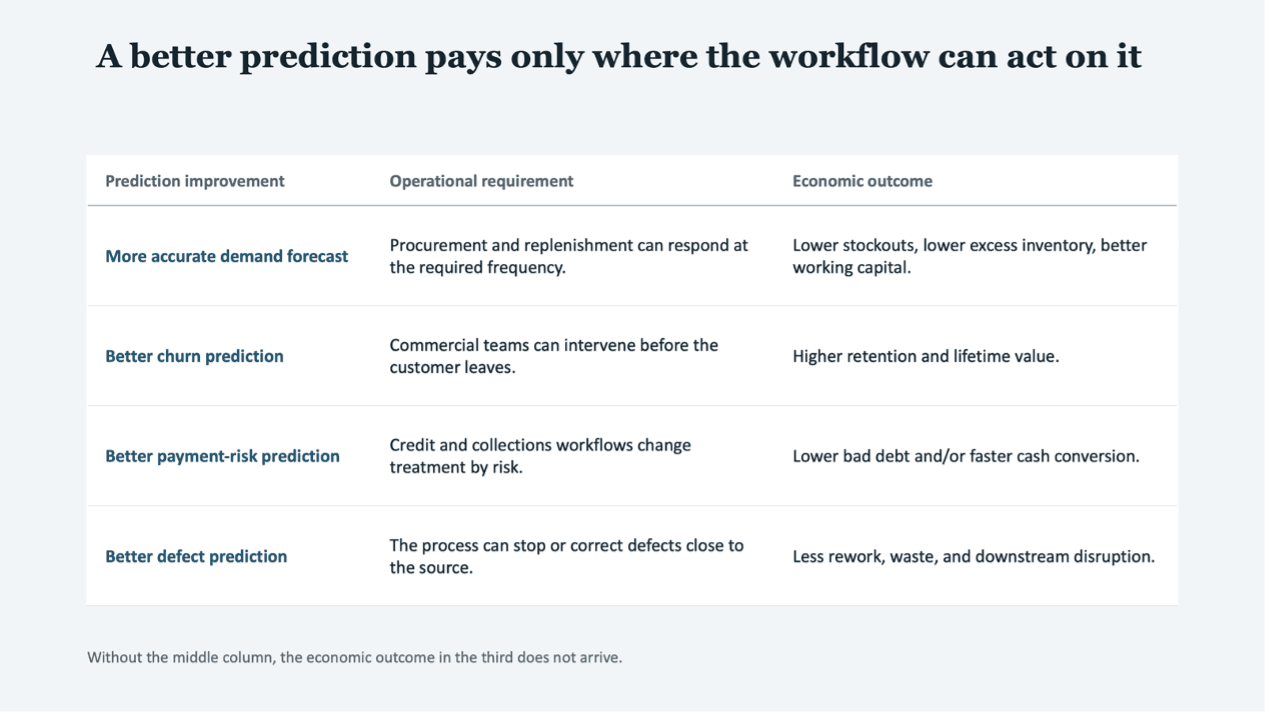
The value of AI is determined not only by how much better the organization can predict, but by how quickly and effectively the operating model can act on the prediction.
Attack Queues and Cycle Time, Not Only Labor Cost
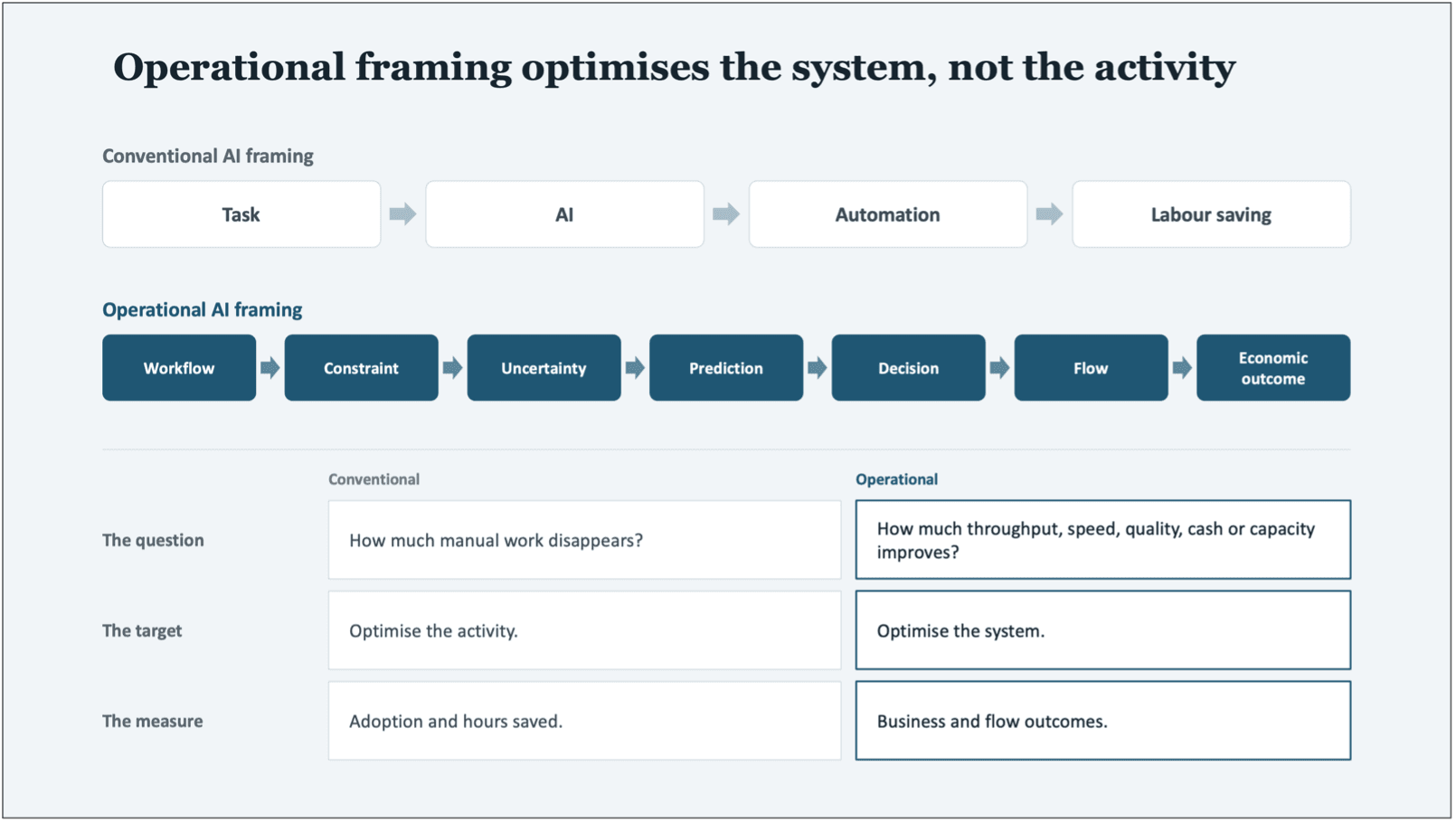
The conventional AI business case often begins with labor hours saved. A broader, more valuable lens focuses on elapsed time and flow. A process may require little actual touch time yet still take days or weeks because work spends most of its life waiting in queues or moving between functions.
Fully automating one task within a business process can still create bottlenecks in the next step, putting the desired overall outcome at risk.
Illustrative example: credit approval
Assume a credit decision involves three days waiting for information, two hours of analysis, two days waiting for review, and one more day waiting for approval. Automating the analysis alone may save only one hour overall if the main bottlenecks remain in the review and approval steps.
By contrast, AI that assembles missing information, predicts risk, routes exceptions, and enables routine cases to proceed automatically could remove several days from the process.
A better AI question is not only “How many labor hours can we save?” but “How much elapsed time and trapped work in process can we remove from the system?”
Move from Task Automation to Flow Improvement
Task automation is useful, but it is not equivalent to operational transformation. The first operating question should be how value flows from beginning to end. AI can then be applied to the prediction and decision points that materially alter that flow.
Illustrative example: accounts receivable
A narrow AI initiative might automate collection emails. A system-level analysis would map the full order-to-cash flow and ask why cash is delayed. The real bottleneck may be disputed invoices, missing documentation, commercial clarification, credit-note approval, or manual prioritization.
• Predict which invoices are likely to be disputed before they are issued.
• Predict which customers are likely to pay late.
• Classify the likely root cause of disputes.
• Recommend the next collection action.
• Route only high-risk or ambiguous accounts to human review.
The target then changes from reducing collection-team hours to reducing dispute cycle time, DSO, and cash trapped in the process.
AI Can Accelerate Feedback and Organizational Learning
Prediction Machines distinguishes feedback data as outcome information that improves future predictions. By shortening the steps within a task and amplifying feedback loops, problems can be discovered close to their source and rework is avoided.
Prediction → Action → Outcome → Feedback → Better prediction
The speed of this loop matters. The longer an organization takes to react to changes in customer demand, and the less frequently it adjusts prices, promotions, products, or processes, the more slowly it learns and reacts, even if its analytical capability is sophisticated. Smaller batches and shorter operating cycles allow the organization to test, observe, learn, and adjust more frequently.
Learning velocity as an advantage
Once the relevant business outcome, process constraint and uncertainty have been identified, the initial AI prediction capability becomes the starting point for improvement rather than the end point.
The advantage can increase over time when the organization shortens the cycle between prediction, action, outcome and feedback. The faster that loop operates, the more frequently the system can learn, adjust and improve both the prediction and the process around it.
Competitive advantage can therefore come not only from the quality of the initial prediction, but from the speed at which the operating system learns from outcomes and improves subsequent decisions.
Human Judgment Determines Where Automation Stops
Prediction Machines distinguishes prediction from judgment. Prediction estimates what is likely to happen; judgment determines the value of outcomes, acceptable trade-offs, and the cost of being wrong. This distinction is essential when designing operational automation because it clarifies where human oversight is required, such as in call center interactions or credit approvals that involve unusual cases or material consequences.
Operational design should reflect prediction confidence × consequences of error.
From AI Prediction to Economic Outcome: The Logic
AI should not be introduced into an operating process simply because a task can be automated. The starting point is the business outcome the organization wants to improve and the end-to-end process that produces it.
Within that process, management must identify the constraint limiting performance and determine whether uncertainty contributes to that constraint. If better prediction can materially reduce that uncertainty, AI becomes a potential solution—but not necessarily an economically attractive one.
Business Outcome → Process → Constraint → Uncertainty → AI Prediction → Judgment → Action → Redesigned Flow → Outcome → Feedback
The prediction must improve a decision. The decision must lead to an action. The operating process must be capable of responding to that action without simply transferring the constraint somewhere else. Human judgment should remain where prediction confidence or the consequences of error make full automation inappropriate.
Finally, the economic benefit of the redesigned process must exceed the full cost of the AI solution, the remaining human resources required to operate it, and the economic consequences of prediction errors.
Economic Value Created > AI Cost + Remaining Human/Process Cost + Cost of Errors
The logic is therefore straightforward: start with the business outcome, understand the process and its constraints, determine where better prediction can change the flow of work, and only then assess whether AI creates a positive economic return.
Putting the Framework into Practice: A Credit Approval Process
Consider a B2B company processing 10,000 credit applications per year. The objective is to increase profitable sales while controlling credit risk and reducing approval time.
The existing process takes six days: three days collecting information, two hours of credit analysis, two days waiting for review, and one day for final approval. Automating the analysis alone would therefore have limited impact on total cycle time.
An AI-enabled process could collect and validate information, predict credit risk, recommend credit limits, and route only exceptions to human review.
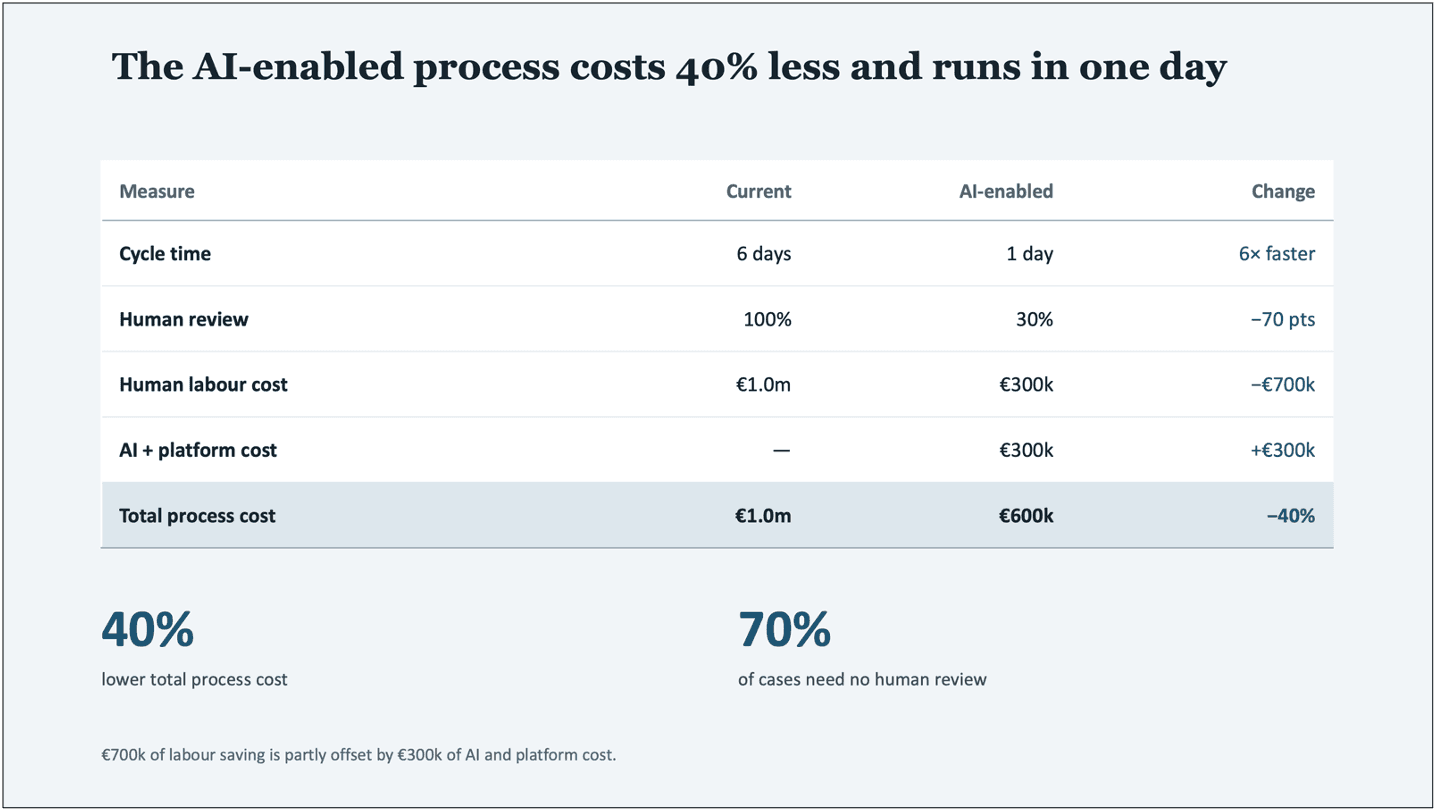
The direct saving is €400k. But the larger value may come from the business outcome: faster approvals can reduce customer abandonment and increase sales, while better risk prediction can reduce bad debt.
The business case must therefore consider AI cost, remaining human cost, prediction errors, process constraints, and the resulting revenue, cash or risk improvement.
The objective is not to automate the credit task. It is to improve the economics of the end-to-end credit process.